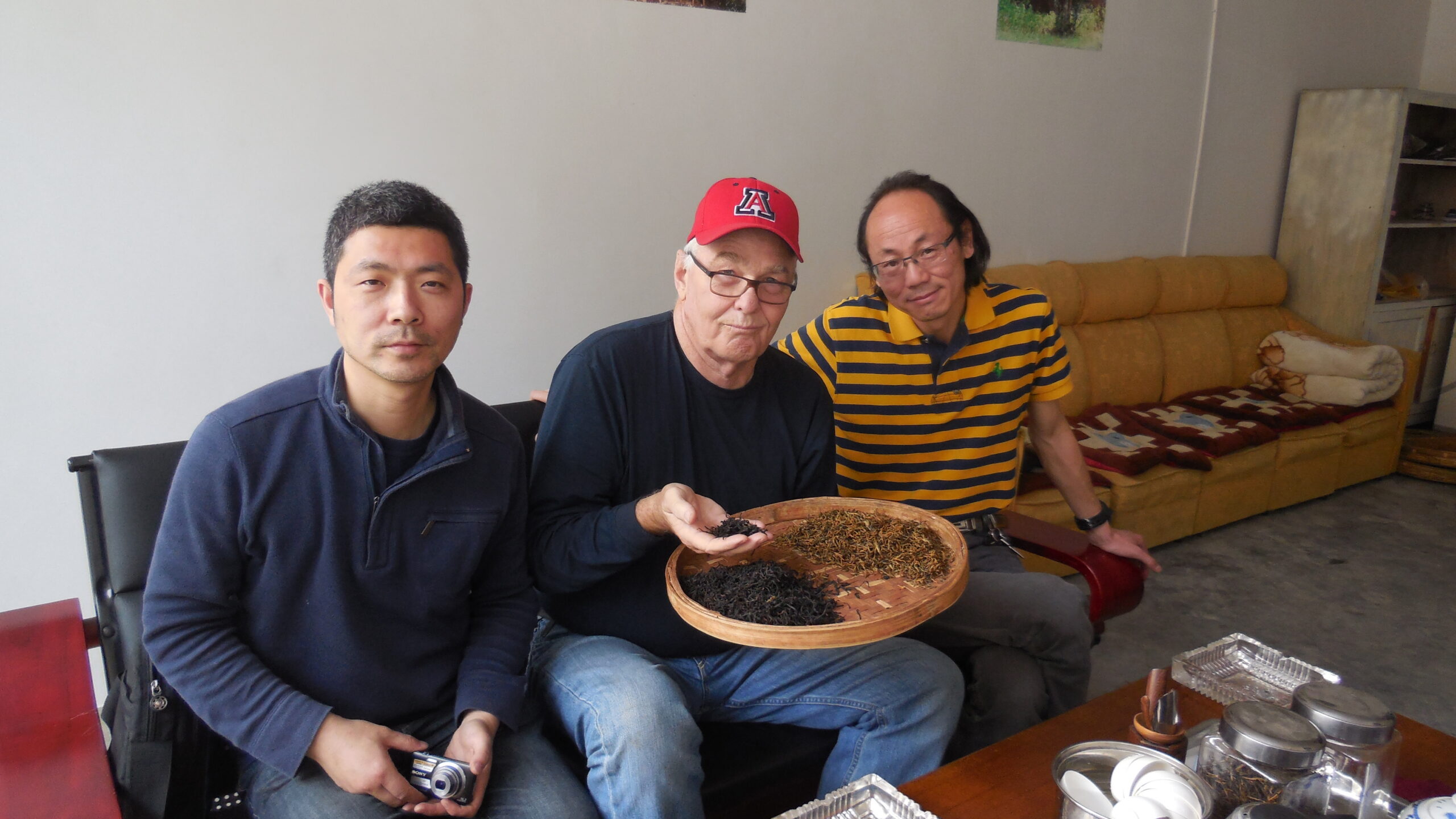
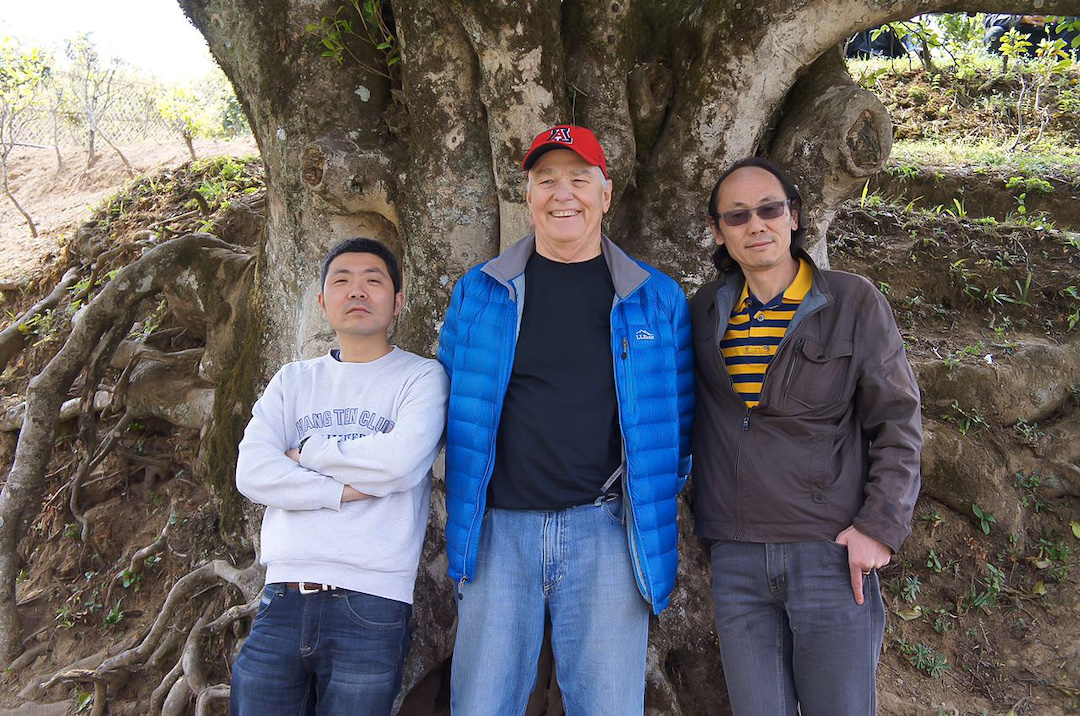
Chen Keke and Li Dong have made a name for themselves with some truly excellent new-process shu puer from their custom factory in Youleshan, Yunnan, such as our Shanye Tian (Woodland) and the Cha Tao (Aged Old Tree) cake.
When we first started buying muddy black bricks of shu puer tea in the early 2000s, this tea was treated with an air of mystery. Shu puer’s signature microbial ripening or “solid-state fermentation” process had been around since the early 1970s, but written knowledge about this process was spotty.
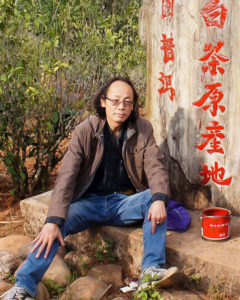
Today, there is a wealth of research on shu puer, in part due to the efforts of scientists like Chen Keke. Chen knows his tea but he also knows his mushrooms, molds, and microbes. During his career in research, he studied mycelium (fungi) at the University of Oregon; and microorganisms at work in shu puer processing at the Chinese Academy of Science in Kunming, Yunnan. Today, he works at the Kunming Institute of Botany, submerged in researching mycorrhizal (the symbiotic relationship between fungi and plant roots) and edible and medicinal fungi. Throughout his career, he’s discovered and documented important bacterial groups and microbes for ripening shu puer that make his tea what they are today.
His career has also brought him to watch over the Xiangzhuqing tree, one of the oldest and largest tea trees in the region. Each season, Chen Keke visits the tree, monitoring the molds and moss and teaches Han Fenqing, the tea maker that makes our Laoshu Dianhong (Old Tree Yunnan), how to take care of the tree. The tree is strictly monitored and the only reason we were able to visit the tree itself is because of our close connection to Chen Keke.

Chen puts his research into practice at their custom-built factory in Youleshan and experiments with maocha (sun dried sheng puer tea) sourced from varying areas of Yunnan with his own patented starter of microbes. These microbes were chosen due to their nature in aiding the ripening process, creating the best flavor and minimizing the risk of damaged leaves. Shu puer is usually made in large 20+ ton batches, which makes the risk of losing a batch of tea very steep; however using less tea leaves for a batch means there is not enough material to produce enough heat for the microbes to grow and metabolize. Shu puer processing used to be fraught with risk, but Chen’s starter of microbes have made it possible for him to ripen shu puer in smaller batches, around 3-5 tons, greatly reducing risk and allowing him to use rare, expensive, or single origin materials.
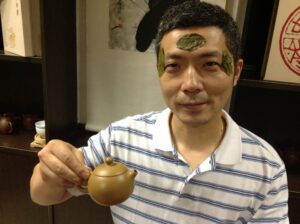 Li Dong, Chen’s partner, has long been interested in tea, but his career in the puer industry began in 2007 at Cha Ma Si, before opening his business with Chen Keke. Li is exceptionally passionate for direct sourcing and quality tea and has carefully documented everything we could want to know about the tea and then some. For any tea we buy, he knows their storing conditions, quality, plants age and maintenance, and processing methods. Multiple regions in China are off-limits to non-locals, one region in Yunnan being Zhenkang County, which produces our Yan Zi Tou (Rock Head) cake, on the western edge of Yunnan. We are very lucky to have Li Dong and Chen Keke to source and ripen these spectacular teas.
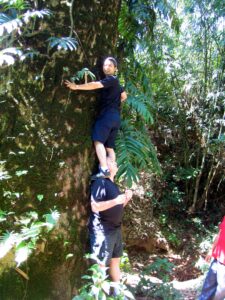
Li and Chen’s dedication to quality and knowledge is not the only thing that makes them exceptional tea makers, they are also some of the biggest party animals we know. While skill and precision are invaluable to sourcing and making tea, strong relationships are worth more than gold to the ethnic minorities in Yunnan. Along with making tea, these communities also make alcohol from corn and tea leaves, called baiju, a white alcohol with a remarkably high alcohol content; and they love to drink. Li Dong and Chen Keke are known to drink, dance, and sing with the tea makers they buy from, building strong, life-long friendships. Chen Keke’s wife even jokes that she has to supervise so they do not go too overboard while drinking during their travels to these communities.
Austin and Zhuping spent a couple weeks traveling across Yunnan with Chen Keke and Li Dong in 2015, watching Chen scramble up tea mountains in his leather jacket with a cigarette in his lips and his hair blowing every which way, and Li Dong loudly laughing and talking about everything that comes to mind. With Chen at the wheel, it was an experience that Austin describes as “oh god.”
Chen Keke and Li Dong’s love for traveling, meeting new people, and partying have built these relationships that make sourcing exceptional maocha possible, fueling the quality and smoothness of their shu puers.