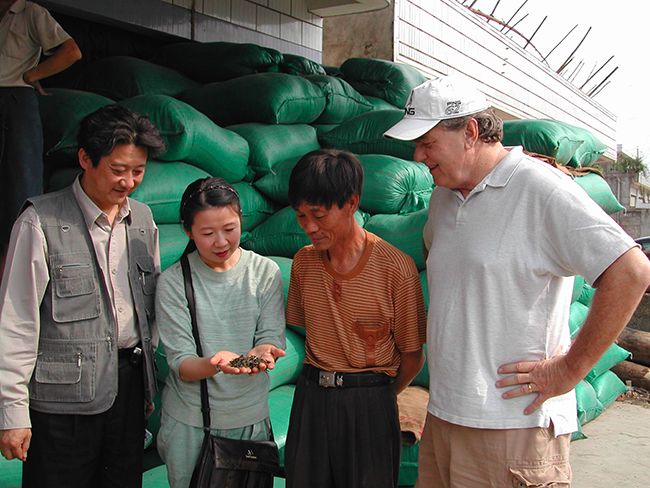
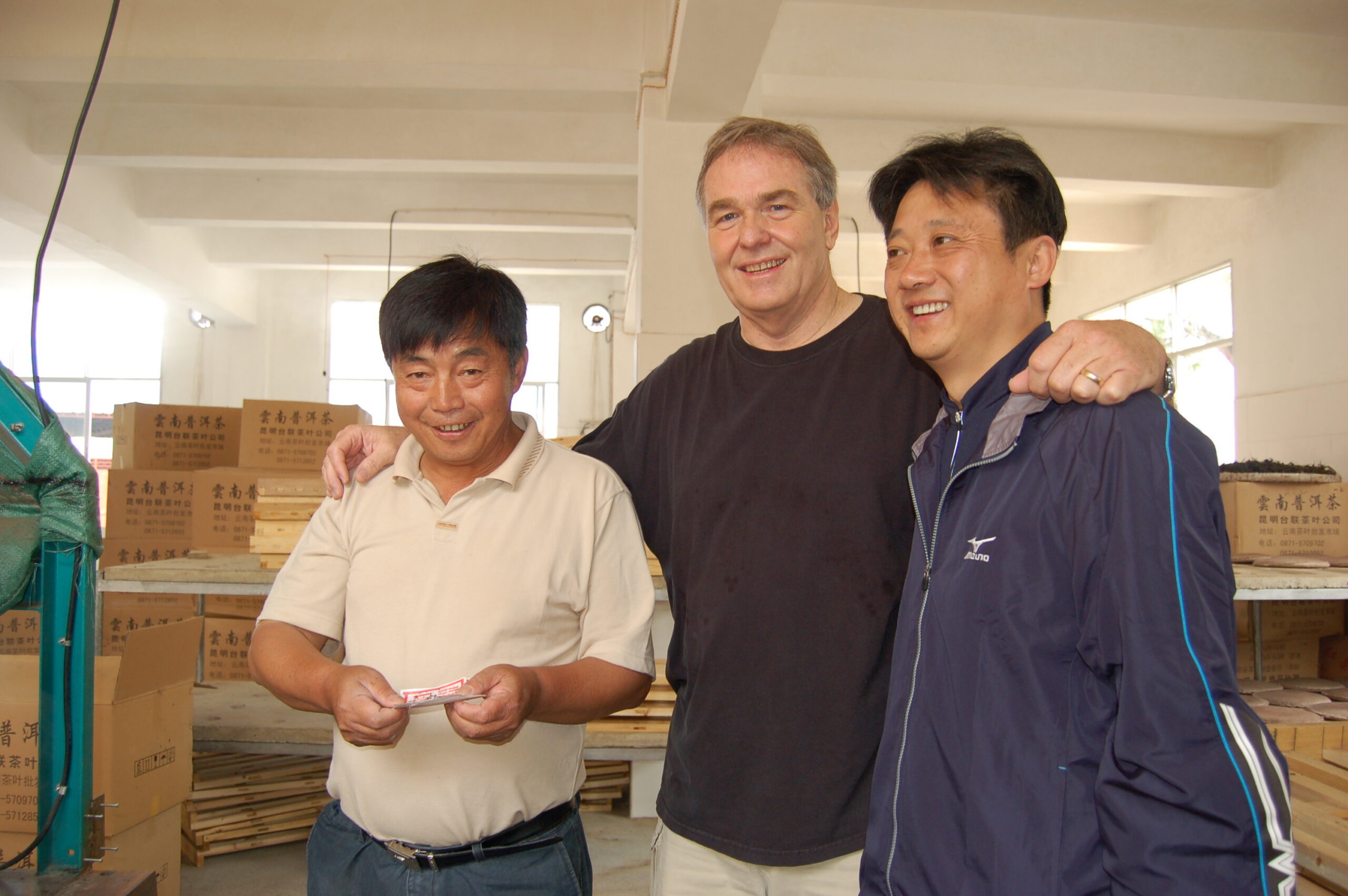
Hu Haoming and Wang Xiqun have long been highly regarded in the puer tea industry for their quality teas and skilled ripening methods. Together, they own and operate their business, Cha Ma Si, and are especially skilled in sourcing high quality, authentic maocha (loose leaf, sun-dried sheng puer) and making high quality shu puer.
Wang Xiqun spent many years developing a new “microbial ripening” technique, a style of tea processing that involves solid-state fermentation and makes shu puer, a tea that is dark, earthy, and remarkably smooth on the tongue. Shu puer ripening is known for being challenging to control the internal temperature and oxygen levels throughout the tea leaves, making it difficult to monitor and control the speed at which microbes and molds grow and metabolize. Wang Xiqun’s methods allow him to increase airflow in the large piles (around 10-20 tons) of ripening tea leaves, which allows him to more precisely control temperature and oxygen levels, and effectively reduces the risk that comes with shu puer ripening making it possible to use high quality leaves and make sweeter, smoother teas.

Hu Haoming grew up in a tea family. His father made high quality jasmine and green teas, the most commonly drank tea at the time in Yunnan. The category of puer tea has been around for centuries and was named after Puer County (renamed Ninger County in 2007), a dense center for distribution of Sheng Puer. Shu puer came around in the early 1970s, though green and jasmine teas remained the daily drink of the people in Yunnan and puer teas were export products, produced by government factories. Hu Haoming and Wang Xiqun bought one of these government factories in Jinggu County, a southwestern county in Yunnan province. Shu puer had been made in this factory for decades, adding to the appeal for Hu. He states that an old factory in shu puer ripening is especially valuable because it’s environment possesses many of the necessary microbes and bacteria for shu puer ripening. Today, Hu Haoming continues sourcing sheng puers and making shu puers as well as lecturing at universities on the history of Yunnan tea and the tea and horse trade.
Wang Xiqun came into the tea world during the 1970s while traveling all over west Yunnan as a guard for caravans, protecting them from animals and thieves. Caravans would often go deep into the mountains, visiting small villages and local minorities in regions that are difficult to get to otherwise. The caravans would purchase their teas and take it to city centers for distribution. During these trips, Wang built strong relationships with the isolated communities, he was exceptionally kind to them, spending most evenings drinking with them. Even returning without the caravans, the people welcomed him and these relationships are what allows him to source high quality maocha.
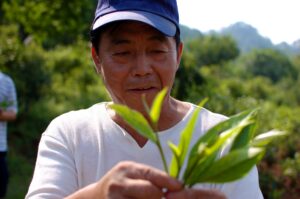
Wang has contributed greatly to the puer industry. He learned shu puer ripening methods in the 1990s and developed his own methods, mentioned previously, and spearheaded the Yunnan Wholesale Tea Market, which has become a major distribution center today, creating more opportunities for small tea makers.
One of the defining moments of Puer tea history was the puer economic bubble. In 2007, the puer market grew massively with prices for aged puer climbing 3-4 fold and peaking in May of 2007. By August the bubble popped and prices dropped, leading to some sellers going out of business due to buying large quantities of aged puer for prices that they could no longer sell at. The sharp popularity led to refinements in ripening techniques, making facilities cleaner and safer, as well as creating a demand for higher quality raw materials and overall improving the conditions of the industry all together. Although an overwhelming period that negatively affected the many businesses that tried to cash in during the bubble, Wang and Hu are unique in their passion for puer tea, producing high quality puers even before there was a market to warrant it. They are continuously striving and innovating to improve the quality of their shu puers and support small family tea makers throughout Yunnan Province.
Seven Cups has sourced tea from them since 2005 and traveled all over Yunnan together almost every year since. Together, they’ve explored the Lincang, Kunming, Daxueshan, Xiaohuzhai, Fenqing areas and many more. Austin and Zhuping are very grateful to call them friends and continue to supply their tea each year.
You can read more about puer tea here!