
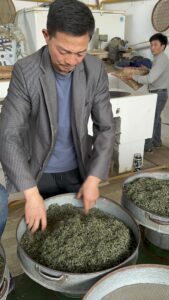
Mu Zegang is an rare yellow tea maker in Mengdingshan (Mengding Mountain), making green and yellow teas from heirloom tea bushes in his high altitude garden.
Austin first met Mu, whom he calls “Xiao Mu,” in 2024 through Luo Ping, one of our sources for Sichuan green and jasmine teas. Austin was the first foreigner Mu had ever met, and in the excitement, Mu ran down the hill to meet Austin, gave him a cigarette (although Austin does not smoke, he accepted it and put it behind his ear), and swiftly turned back around and ran back up the hill remarkably quickly to grab his, quote, “best blazer.”
Mu, like Luo Ping, grew up making tea with his family, the skill passed down from grandparents and neighbours. Meeting Mu in the first place was incredibly uncommon and a privilege only made possible through our close friendship with Luo Ping, and Luo Ping’s close friendship with Mu.
In large mountain regions like Mengdingshan in Sichuan or Jingmaishan in Yunnan, it’s most common to buy tea through middle men who travel into the mountains and source tea from small communities. In Mengdingshan particularly, it’s very difficult to meet the tea makers themselves and visit the gardens; the middle men often keep the farmers and tea makers like protected secrets.
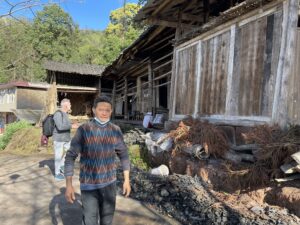
Another special feature of Mu’s teas is that they come from heirloom tea bushes. Heirloom tea bushes are seed-grown, and while the title “heirloom” makes them sound prized, their value has only been appreciated since around the 2010s, making heirloom gardens exceedingly rare. Prior to the 2010s, tea cultivars (cloned propagations of a successful bush) such as Anji Baiye #1 or Longjing #43, were heavily promoted by the government and incentivized, leading to many families removing heirloom bushes and planting cultivars, which could be sold at higher prices.
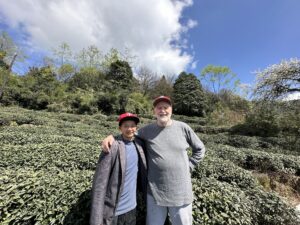
Into the 2010s, more and more research found value in heirloom teas such as having more complex flavor and higher nutritional content than the propagated cultivar plants. However, by then, most heirloom bushes had been removed to make room for cultivar tea bushes. Mu’s heirloom garden, however, remains because his family could not afford to buy cultivars. Had they been able to, they would have. (Which reminds me a lot of the Doaist story “Sai Weng Lost His Horse,” and I recommend reading it). Today, the government that actively discouraged heirloom gardens is now actively supporting heirloom tea farmers.
As if his high altitude, heirloom gardens did not make his teas special enough, Mu also makes Mengding Huangya (Mengding Yellow Buds), a wonderful and rare handmade yellow tea. It’s rarity is driven by the labor intensive process and scarcely known of, even in China. Because of this, Mu only makes yellow tea when specially ordered, as do our other yellow tea producers such as Wang Xiangzhen and Gao Xiaozu.
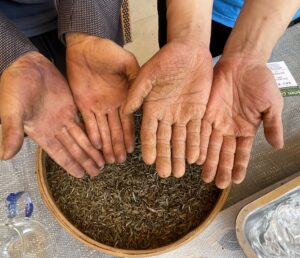
Mu, his wife, and son continue making heirloom teas, specializing in green and yellow teas. We are extremely grateful to call him a friend and bring his tea to you.
Read more about Mu Zegang’s green tea, yellow tea, and the history of yellow tea.