
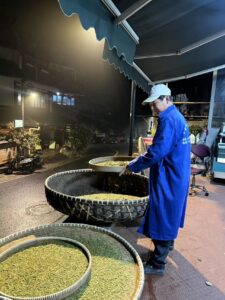
We are privileged to offer authentic Shifeng Longjing directly from the Weng family. Weng Shangyi made Shifeng Longjing for us since 2007, but sadly passed away in 2019 at the age of 90. He taught Chen Xiaochao, who has been working for the Weng family making Longjing tea for decades, assisted by Weng’s granddaughter-in-law, Cheng Wenjing. Chen still makes this historic tea almost entirely by hand using leaves from seed-grown bushes from the Weng family’s tea garden in Wengjiashan Village of the Shifeng Mountain region.
Chen Xiaochao began learning to make Shifeng Longjing with Weng Shangyi in the early 2000s. Each spring, he would travel from Anhui Province to Zhejiang Province to learn the techniques and methods of making Shifeng Longjing. After the spring tea season ended, he returned home, where his family makes Lu’an Gua Pian green tea, and applied what he learned to help his family make higher quality tea. Although the tea industry is often passed down to the tea makers children, well known tea makers often have students. Some of our tea makers such as Wang Xiangzhen from Mogan Mountain, or Liu Guoying from Wuyi Mountain, have taught many students.

The Weng family’s farm has passed down their seed-grown heirloom tea bushes from generation to generation. Weng Shunqin, Weng Shangyi’s daughter, is a knowledgeable tea maker in her own right, who looks after the management of the family tea gardens, and the harvest season. Her son, Guo Jianming, manages the sale of the family’s tea, while his wife, Cheng Wenjing, has been learning to make Shifeng Longjing by hand at Chen Xiaochao’s side.
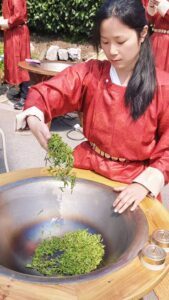
Cheng Wenjing, affectionately nicknamed Cheng Cheng, did not grow up around tea farms but always enjoyed drinking it. After marrying into the Weng family, she was eager to learn the traditional methods to make Shifeng Longjing. She met her husband, Guo Jiaming, while he was selling osmanthus perfume and tea from his family’s farm, where the fragrant osmanthus flowers grow among the tea bushes. Though Cheng has a university education and her husband does not, she unconventionally chose to marry him and join the family on their farm, devoting herself to the craft of tea. Together, they have a son, who loves science, and a daughter, who loves art and drawing.
Cheng Wenjing’s passion and drive come from her deep respect for the delicate balance that defines tea-making. She is often studying and volunteering at the National Tea Museum in Hangzhou City. Cheng has shared with Zhuping that she even likes the calluses in her hands, due to the high heat of the frying process, she says they are a sign of her hard work and look like pearls on her fingers and palm.
Seed-grown bushes in a commercial market
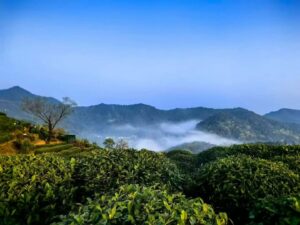
Often with famous teas, such as Longjing or Anji Baicha, the government will promote a specific commercial cultivar, often leading to farms removing seed-grown varieties to plant the commercial cultivar. In tow, most Longjing green tea on the market is made from a commercial cultivar known as Longjing #43 (our Da Fo Longjing is made from this bush). Despite the government’s efforts to spread the Longjing #43 cultivar, and their continuous pressure on the Weng family to plant Longjing #43, Weng Shangyi insisted on keeping their old, seed-grown tea bushes. The strong and deep root systems of these bushes brings a rich and unique flavor, with each individual bush bringing their own distinct qualities.
Although the government previously pushed cultivars, after 2010, researchers realized how valuable heirloom bushes are for their higher nutritional value and richer flavor, and now the government encourages and protects heirloom gardens, as rare as they are still.
Longjing from the Shifeng area enjoys historical prestige as a tea favored by emperors. Today, it is still regarded as a national treasure and is often used as a state gift. It’s the villages yearly duty to sell some of their earliest harvested tea to the government before they could begin selling tea to anyone else. We have selected one of their earlier harvests of Shifeng Longjing to bring to you all.
Read more about Longjing green tea here!